
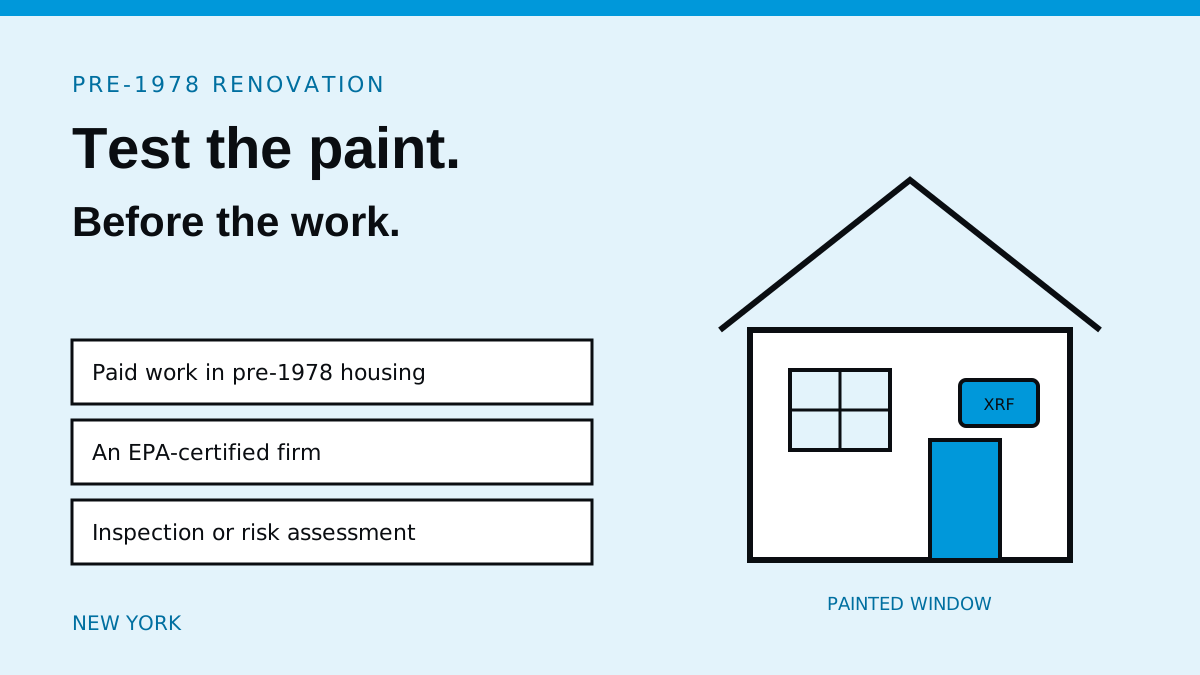
EPA’s Renovation, Repair and Painting (RRP) rule covers paid work that disturbs paint in housing built before 1978 and in child-occupied facilities such as day care centers. Under the rule, that work is done by an EPA-certified firm using the rule’s dust-control work practices, unless an exemption applies. A lead inspection or risk assessment before the job shows where lead-based paint is, so everyone knows which parts of the project the rule covers. For testing, see our lead inspections and risk assessments page or call 518.832.9213.
Does the RRP rule apply to your project?
The RRP rule is in federal regulations at 40 CFR Part 745, Subpart E. It applies to renovations “performed for compensation” in target housing and child-occupied facilities (40 CFR 745.82). In plain terms:
- Who is covered. Anyone paid to do the work, including contractors, painters, plumbers, electricians, landlords and property management companies. Under 40 CFR 745.89, these firms must be certified by EPA, and each job needs an assigned certified renovator.
- What housing. “Target housing” is housing built before 1978, except housing for the elderly or persons with disabilities and 0-bedroom units such as studios, unless a child under 6 lives there or is expected to (40 CFR 745.103).
- What work. “Renovation” is broad: sanding, scraping, window repair, removing walls or windows, and weatherization cuts in painted surfaces (40 CFR 745.83).
- The pamphlet step. No more than 60 days before work starts in a home, the firm is required to give the owner (and an adult occupant, if the owner doesn’t live there) EPA’s Renovate Right pamphlet and document that it was delivered (40 CFR 745.84).
EPA says the rule generally does not apply to homeowners working on their own home, unless they rent out part of it, run a child care center there or flip homes.
RRP rule exemptions
The rule does not cover (40 CFR 745.82 and 745.83):
- Minor repair and maintenance. Work that disturbs 6 square feet or less of painted surface per room inside, or 20 square feet or less outside. This never covers window replacement, demolition of painted surfaces, or work using a prohibited practice such as open-flame burning or high-speed sanding without a shroud and HEPA vacuum attachment. Jobs in the same room within 30 days count as one job.
- A written determination by a certified inspector or risk assessor that the components affected by the renovation do not contain lead-based paint. The renovation firm needs a copy of that determination.
- A certified renovator’s test. A certified renovator can test each affected component with an EPA-recognized test kit, or send paint chip samples to an EPA-recognized lab, and find that the components do not contain lead-based paint.
HUD-assisted housing has stricter “de minimis” limits under 24 CFR 35.1350: 2 square feet per interior room, 20 square feet outside, or 10 percent of a small component such as a windowsill or trim.
What is a lead risk assessment?
A lead risk assessment is an on-site investigation to find lead-based paint hazards, meaning conditions that can expose people to lead now, and to report options for controlling them (40 CFR 745.223 and 745.227(d)). A certified risk assessor looks for deteriorated paint, tests deteriorated painted surfaces, takes dust wipes from floors and windowsills, and samples bare soil in play areas, the yard and along the foundation. The report describes each hazard, the options to control it, and a suggested order for the work.
Lead inspection vs risk assessment
| Point | Lead inspection | Lead risk assessment |
|---|---|---|
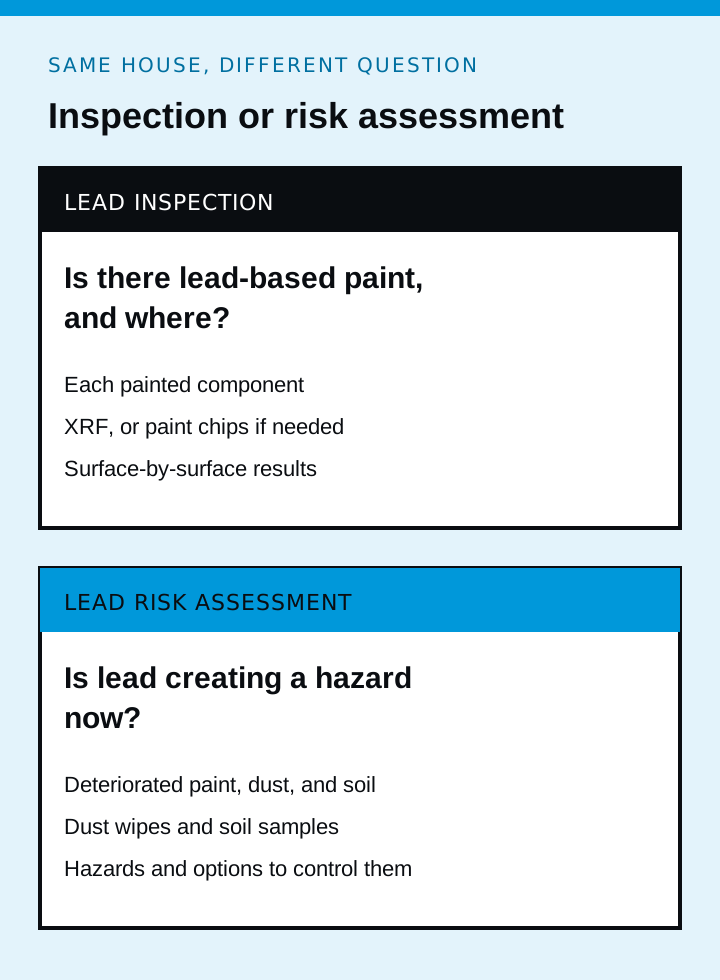
| Question it answers | Is there lead-based paint, and where? | Is lead creating a hazard now? |
| What is tested | Each painted component with a distinct painting history, inside and out (40 CFR 745.227(b)) | Surfaces with deteriorated paint, plus floor and windowsill dust and bare soil (40 CFR 745.227(d)) |
| Typical tools | XRF paint testing, paint chip samples if needed | Visual review, XRF, dust wipes, soil samples |
| Report | Surface-by-surface results | Hazards found and options to control them |
An XRF analyzer measures lead in paint without removing it. Federal rules define lead-based paint as paint with lead at or above 1.0 milligram per square centimeter (40 CFR 745.103). Our inspectors report any reading of 1.0 mg/cm² or higher as positive, including a reading of exactly 1.0.
Under 40 CFR 745.227(b)(4), an inspection report includes, among other items, the testing method, the XRF serial number, the location of each painted component tested, and the results. Our reports list each component with its substrate (such as wood, plaster or metal), its room and location, and its XRF reading, so a contractor can see exactly which surfaces tested positive.
Which one do you need before renovating?
Our recommendations:
- Planning work that disturbs paint. A lead inspection of the components your project will disturb is recommended. A written determination from a certified inspector or risk assessor that those components do not contain lead-based paint is one of the RRP exemptions. Where components do test positive, the contractor knows exactly where RRP work practices apply.
- Young children in the home, or visible deteriorated paint. A lead risk assessment is recommended, because it looks at dust and soil as well as paint.
- Buying a home. Either can help, depending on whether you want to know where lead-based paint is or whether hazards exist today.
Rental owners have one more thing to check. New York’s Lead Rental Registry covers rental housing built before 1980 with two or more units in 25 communities of concern, including Albany, Schenectady, Troy, Amsterdam and Gloversville. Its rules are in 10 NYCRR Subpart 67-5. See our guide to getting ready for a registry inspection and our NY Rental Lead Registry inspections page. New York City has its own lead rules under Local Law 1 of 2004, which this guide doesn’t cover.
If the project may also disturb building materials, see our guide to an asbestos survey before renovating.
After the work: cleaning verification and clearance
When an RRP job ends, the rule calls for cleaning verification (40 CFR 745.85(b)). The certified renovator wipes windowsills, floors and countertops with a disposable cloth and compares it to an EPA verification card, re-cleaning until it passes. Outside, the check is visual. It is the renovator’s own check, and no lab result is produced.
Lead dust wipe clearance is a different, stronger check. A certified inspector or risk assessor collects dust wipe samples, and a lab measures the lead in each one. The rule allows dust clearance testing in place of cleaning verification when the contract or another law calls for it (40 CFR 745.85(c)). In that case, the work area is re-cleaned until results are below EPA’s dust-lead action levels.
Those action levels changed under EPA’s 2024 rule (89 FR 89416). Since January 12, 2026, clearance results need to be below:
- 5 µg/ft² on floors
- 40 µg/ft² on interior windowsills
- 100 µg/ft² on window troughs
Abatement clearance uses the same levels (40 CFR 745.227(e)(8)). Clearance by a firm that didn’t do the work keeps the result independent. More detail is on our lead clearance section.
EPA’s role in New York
New York has not been authorized by EPA to run its own RRP program, and EPA administers the lead-based paint activities program (inspection, risk assessment and abatement) in New York. That means renovation firms, renovators, inspectors and risk assessors working in New York are certified by EPA under the federal rules above. State rules, such as the Lead Rental Registry, apply on top of the federal ones.
Working with ClearVU
ClearVU Environmental provides Lead inspection, Lead risk assessment and Lead dust wipe clearance in New York through EPA-certified staff. We test and assess only. We don’t do abatement or renovation, so our results stay independent of the contractor. Dust wipe samples are analyzed by independent, accredited partner labs. Call 518.832.9213, email support [at] cvenv [dot] com or contact our team.
More answers are on our FAQ page, and more guides are in our guides library.
Frequently asked questions
Short answers first.
Does the RRP rule apply in New York?
Yes. EPA runs the RRP program in New York, so the federal rule applies to paid work that disturbs paint in pre-1978 housing and child-occupied facilities.
What is a lead risk assessment?
An on-site investigation by a certified risk assessor that finds lead-based paint hazards in paint, dust and soil, and reports options to control them.
What's the difference between a lead inspection and a risk assessment?
An inspection finds where lead-based paint is, surface by surface. A risk assessment finds whether lead is creating a hazard now.
What jobs are exempt from the RRP rule?
Minor repair and maintenance under EPA's area limits, and work on components a certified inspector, risk assessor or renovator has determined do not contain lead-based paint. Window replacement never counts as minor repair.
Do I need a lead inspection before renovating a pre-1978 home?
Federal rules don't require one in every case, but it is recommended. It shows which components contain lead-based paint, so the contractor knows where RRP practices apply.
Does a homeowner doing their own work need RRP certification?
Generally no. EPA says the rule doesn't cover homeowners working on their own home unless they rent it out, run a child care center there or flip homes. EPA still recommends dust-control work practices.
Request a lead inspection or risk assessment
Call 518.832.9213 or email support [at] cvenv [dot] com. Sample drop-off at our Queensbury office.