
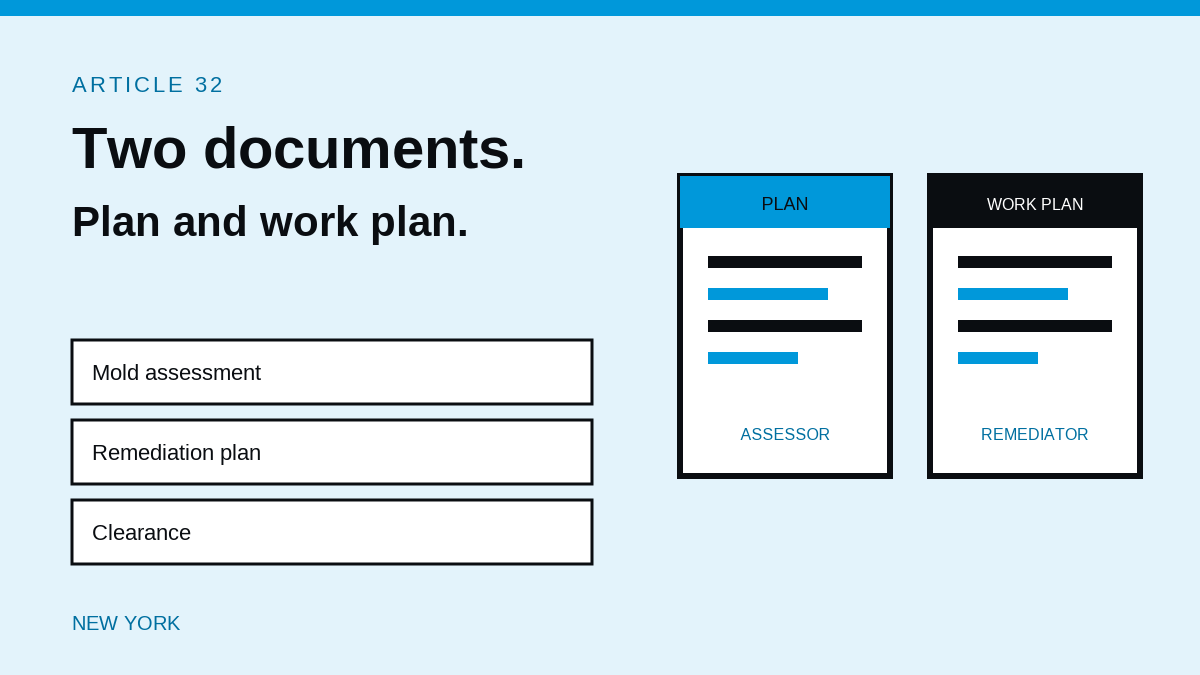
Short answer: no. In New York, Article 32 of the Labor Law licenses mold assessment and mold remediation. No licensee may perform both on the same property, and no person may own an interest in both the assessment licensee and the remediation licensee on that property. A licensed mold assessor writes the mold remediation plan and later does the post-remediation assessment. A separate licensed mold remediation contractor writes the mold remediation work plan and does the cleanup.
For a mold assessment, the plan, or mold clearance, see mold assessment or call 518.832.9213.
When Article 32 applies
Article 32 covers a mold project. Labor Law §930 defines a project as mold assessment, remediation, or abatement of areas greater than 10 square feet. Routine cleaning is outside that definition, as is construction, maintenance, repair, or demolition done for a purpose other than mold.
The mere presence of mold does not, by itself, require an owner to hire anyone. The NYS Department of Labor says it triggers no obligation to obtain an assessment or perform remediation. Once an owner hires someone for a covered project, the Department of Labor says that person must be licensed and follow the law.
Labor Law §933, and §931 for design professionals, exempts:
- A residential property owner working on their own property.
- A non-residential property owner, or that owner’s employee, on an apartment building of four or fewer units that the owner owns.
- An owner, a managing agent, or a full-time employee of the owner or managing agent, on commercial property or a residential building of more than four units the owner owns, unless the managing agent or employee offers mold work to the public.
- A federal, state, or local government unit or public authority, and its employees, on property that unit owns, manages, or remediates.
- A licensed design professional, such as an architect or engineer, acting within the scope of that practice.
The list is about when the licensing law attaches. It does not decide a health question, an insurance question, or whether a small area of growth deserves attention. New York City housing rules and lease disputes are outside this guide.
For when an assessment is useful, see Is mold testing worth it?.
Can the same company test and remove the mold?
No. Labor Law §936 says no licensee shall perform both mold assessment and mold remediation on the same property. No person shall own an interest in both the licensee who performs the assessment and the licensee who performs the remediation on that property. Two employees of one licensee are still that one licensee.
The NYS Department of Labor describes the separation as protection against fraud and requires an independent mold assessment to define the scope of the work.
A licensed remediator may not start a covered project without an assessment from a licensed assessor. A waiver from the client does not set that aside. The Mold FAQ says the Labor Law does not allow the work without that assessment.
Who writes the mold remediation plan?
The licensed mold assessor prepares a mold remediation plan specific to the project and gives it to the client before remediation begins (Labor Law §945). On the mold service page, this plan is called the protocol.
The statute says the plan must specify:
- The rooms or areas where the work will be performed.
- The estimated quantities of materials to be cleaned or removed.
- The methods for each type of remediation in each type of area.
- The personal protective equipment supplied for the workers who do the abatement.
- The clearance procedures and criteria for each type of remediation in each area.
- When the building is occupied, how occupants will be notified, and notice suited to the project.
- An estimate of cost and an estimated time frame for completion.
- When it can be identified, the moisture source and the type of contractor who should correct it.
The cost and time estimates are statutory elements of that plan. They are not a ClearVU price or a promised schedule.
The contractor’s work plan
The assessor’s mold remediation plan and the contractor’s mold remediation work plan are different documents. The licensed remediation contractor writes the work plan so that it fulfills the assessor’s plan, and gives it to the client before site preparation begins (Labor Law §946). Hand the assessor’s plan to each contractor you ask for a price, so each price follows the same scope.
Signs go up at accessible entrances to the work area. Containment stays in place until the remediation contractor is notified by a mold assessment licensee that the project has achieved clearance.
Repairing the moisture source, such as a roof leak or a plumbing failure, is not mold remediation when it needs expertise outside mold work (Labor Law §930). A roofer, plumber, or other trade usually does that repair. Department of Labor guidance says a remediation contractor is not required to fix the moisture source without that expertise.
After the work: the post-remediation assessment
A mold assessment licensee conducts the post-remediation assessment (Labor Law §947). The assessor checks that the work area is free of all visible mold, that the work matches the mold remediation plan and the work plan, and that it meets the plan’s clearance criteria. To the extent feasible, the assessor also checks whether the underlying cause has been addressed, and recommends a contractor type if it has not.
Department of Labor guidance on what to expect says you should use the mold assessor who wrote the plan, and that this is not required. The remediator does not clear their own work. The written report covers the work area and the plans. It does not cite the remediator’s license.
A successful result is a written passed clearance report to the client. An unsuccessful result is a written final status report to the client and the remediation licensee, recommending a new assessment, completion of the original plan, or attention to the underlying cause. Pass and fail details stay on the service page under mold clearance.
How to check a New York mold license
The NYS Department of Labor lists five mold licenses: mold assessor, mold assessment contractor, mold remediation contractor, mold abatement worker supervisor, and mold abatement worker.
Before you hire:
- Check the business. Use the Licensed Mold Contractors search on the Mold Program page. The open dataset is Mold Contractor Licenses (Four-Year Window).
- Check the person. Use the Mold Individual Licenses search on the Mold FAQ. The open dataset is Mold Individual Licenses (Four-Year Window).
- Look at the work site. Labor Law §931 requires a copy of a valid mold assessment or mold remediation license, displayed conspicuously at the work site.
- Compare the companies. On the same property, the assessor and the remediator are different licensees, with no shared ownership interest.
Use those current pages. Older fact sheets still print outdated labor.ny.gov addresses.
The Mold Program page says home inspectors who assess mold conditions in a pre-sale report must hold a mold assessor license.
Working with ClearVU
ClearVU provides mold assessment, writes the mold protocol (the mold remediation plan), and does mold clearance in New York. Mold clearance is the post-remediation assessment. Our team inspects, writes the plan, and performs that assessment. ClearVU does not remediate, remove, or clean up mold, on this property or any other. You choose the licensed remediation contractor. The assessor checks that work against the plan.
To compare quotes on a New York mold project, start with mold assessment, read how a remediation project is planned, or contact us. Call 518.832.9213.
More guides are in the guides library.
This guide covers New York State law only. It is general information, not legal advice.
Frequently asked questions
Can the same company test and remove mold in New York?
No. A licensee may not perform both mold assessment and mold remediation on the same property, and no one may own an interest in both licensees on that property.
What is NY mold law Article 32?
Article 32 of the New York Labor Law is the state law that licenses mold assessors and remediators and sets minimum work standards, including the independent plan and the post-remediation assessment.
Who writes the mold remediation plan in New York?
The licensed mold assessor writes a project-specific remediation plan and gives it to the client before remediation begins. The remediation contractor then writes a work plan that fulfills that plan.
Does every mold job in New York need a licensed assessor?
Licensing applies to covered projects larger than 10 square feet once a professional is hired. A residential owner working on their own property is exempt from the license. The mere presence of mold does not, by itself, require an owner to hire anyone.
How do I check a New York mold license?
Use the Department of Labor Mold Program and Mold FAQ pages to search licensed mold contractors and individual licensees. Do not rely on the outdated URLs in older fact sheets.
Who does the post-remediation assessment?
A licensed mold assessor. You should use the mold assessor who wrote the plan, but that is not required. The remediator does not clear their own work.
Does a home inspector in New York need a mold assessor license?
Yes, if the inspection or report includes an assessment of mold conditions.
Does ClearVU remove mold?
No. ClearVU assesses, writes the remediation plan, and does the post-remediation assessment. A separate licensed remediation contractor does the cleanup.
Book a mold assessment
Call 518.832.9213 or email support [at] cvenv [dot] com. Sample drop-off at our Queensbury office.