Radon is a naturally occurring radioactive gas from soil and rock, and it can get into any home. You can’t see, smell or taste it, and testing is the only way to know a home’s level. Warren County isn’t on the New York State Department of Health (NYS DOH) list of high radon area counties, but homes at 4 pCi/L or higher do turn up here, so testing is recommended for every home. ClearVU provides independent radon testing and appears on the NYS DOH list of radon testers. Below, our team explains what local data shows, what the numbers mean, and when to test.
Is radon a problem in Warren County?
It can be, home by home. Here is what the public data says:
- State list. Warren County is not on the NYS DOH “High Radon Area Counties” list. Neighboring Saratoga and Washington counties are.
- EPA zone map. EPA places Warren County in Zone 3, its lowest predicted-potential group. EPA also says the map “should not be used to determine if individual homes need to be tested.”
- State test results. In the NYS DOH county test results published since 1987, 71 of 428 Warren County tests (about 1 in 6) read 4 pCi/L or higher. Basement tests averaged about 3.3 pCi/L and first-floor tests about 2.4 pCi/L. These are homes whose owners chose to test, not a random survey, and the figures are reported by county, not by town.
The takeaway is simple. A county average can’t tell you what is in your house. Two neighboring homes can test very differently, so the only reliable answer comes from a test in your own home.
What the numbers mean: 4 pCi/L and the 2 to 4 range
Radon is measured in picocuries per liter of air (pCi/L). EPA and NYS DOH recommend fixing a home if the result is 4 pCi/L or higher. Both also say you may want to consider fixing a home between 2 and 4 pCi/L. EPA notes that levels below 4 pCi/L still pose some risk and in many cases can be reduced.
For health context, one line is enough: radon is the leading cause of lung cancer among nonsmokers, according to NYS DOH and EPA.
Radon testing when buying a house in New York
EPA recommends knowing the radon level in any home you consider buying. Its home buyer’s guide suggests:
- Ask the seller for any radon test results.
- If the home has a radon reduction system, ask the seller for any information they have about it.
- If the home hasn’t been tested, have it tested.
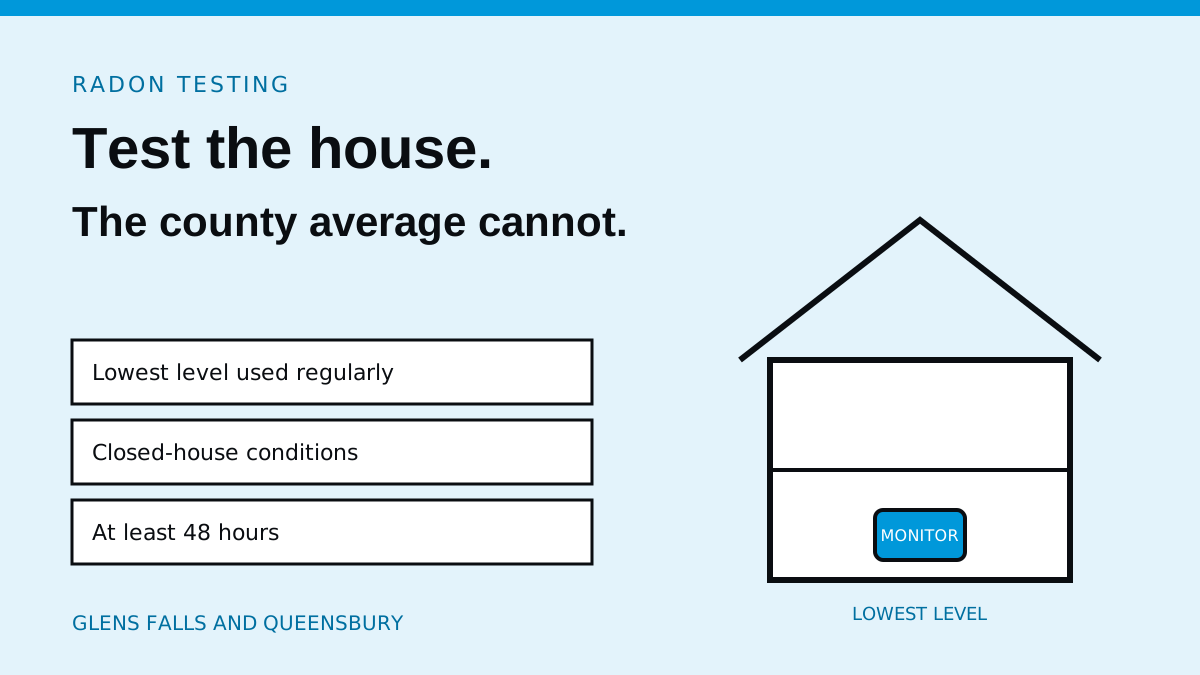
For real estate, EPA recommends testing in the lowest level of the home that could be used regularly, finished or unfinished, because a buyer may use a lower area than the seller did. Tests should run at least 48 hours. For short-term tests under four days, windows and outside doors stay closed starting at least 12 hours before the test and during it.
NYS DOH recommends hiring a certified radon testing professional before buying a home, and checking that the test results come from a laboratory approved through the state’s Environmental Laboratory Approval Program (ELAP).
If you’re selling, EPA recommends testing before you list the home and keeping the results to share with buyers. Any contract terms around radon are between you, the other party and your attorney or agent.
When to test a home you already own
NYS DOH recommends testing:
- Every five years.
- Every two years if the home has a radon mitigation system, to make sure it is working.
- After major renovations.
- Within 30 days of installing a radon mitigation system.
- In winter, when windows and doors can stay closed before and during the test.
NYS DOH, EPA and the U.S. Surgeon General recommend testing all homes, and EPA’s guide specifies homes below the third floor. NYS DOH also recommends testing every new home, even one built to be radon resistant.
How a professional radon test works
A professional test follows a set routine:
- Placement. The device goes in the lowest level of the home that could be used regularly.
- Closed-house conditions. Windows and outside doors stay closed before and during the test. You can still come and go through doors as usual.
- Test period. The device runs for at least 48 hours. Your tester will tell you the period for the device used.
- Retrieval and report. The device is collected and you receive a written result.
ClearVU uses continuous radon monitors, electronic devices that record radon levels at regular intervals throughout the test period, rather than collecting a single sample that is sent away for analysis.
Two points about New York’s rules are worth knowing. First, NYS DOH says New York does not certify or license radon testers. Testing firms on the state list are certified by national or other state programs, such as AARST, NRSB, New Jersey or Pennsylvania, and ClearVU appears on that list. Second, NYS DOH states that “anyone who analyzes and provides the results of those tests must hold New York State Department of Health Environmental Laboratory Approval Program certification.” When you hire any tester, it is reasonable to ask how the results are analyzed and reported.
If your result is high: who does what
If your home tests at or above 4 pCi/L, the next step is a radon mitigation contractor. NYS DOH recommends contacting a certified radon mitigator, who designs and installs a reduction system for your home.
ClearVU does not install mitigation systems. Our role is testing. We can perform the initial test, and after a system is installed we can perform the follow-up test, so the result comes from someone independent of the installer. NYS DOH recommends that follow-up test within 30 days of installation, and testing every two years after that.
To schedule a test, see our radon testing page or contact our team. We serve Queensbury and Glens Falls and the surrounding area.
More answers are on our FAQ page, and more guides are in our guides library.
Frequently asked questions
Short answers first.
Is radon a problem in Warren County, NY?
Warren isn't on the NYS DOH high radon area county list, but about 1 in 6 tests in the state's county data read 4 pCi/L or higher, so testing is recommended for every home.
Do I need a radon test when buying a house in New York?
It's recommended. EPA advises knowing the radon level in any home you buy, and NYS DOH recommends hiring a certified radon tester before purchase.
What radon level is too high?
EPA and NYS DOH recommend fixing a home at 4 pCi/L or higher, and suggest considering it between 2 and 4 pCi/L.
How long does a radon test take?
EPA says tests should run at least 48 hours under closed-house conditions. Your tester will tell you the period for the device used.
Is ClearVU on the New York State radon testers list?
Yes. ClearVU Environmental appears on the NYS DOH list of radon testers for Warren and surrounding counties.
Does ClearVU install radon mitigation systems?
No. A radon mitigation contractor installs systems. ClearVU can provide independent testing before and after installation.
Schedule a radon test
Call 518.832.9213 or email support [at] cvenv [dot] com. Sample drop-off at our Queensbury office.