
Environmental
Community Air Monitoring on New York Brownfield Cleanup Program Sites: What the CAMP Covers
How community air monitoring (CAMP) works on New York Brownfield Cleanup Program sites: what DER-10 covers, what is measured, action levels and daily records.
Published October 26, 2026
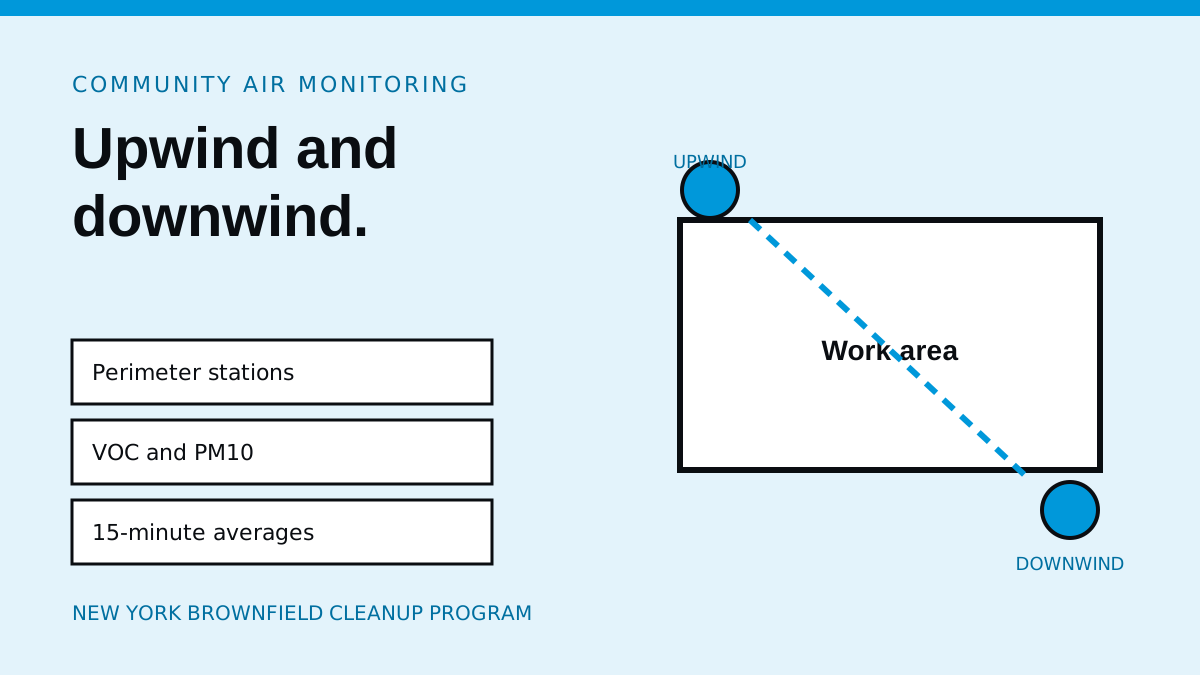
On a New York Brownfield Cleanup Program (BCP) site, community air monitoring follows a written Community Air Monitoring Plan, or CAMP. The plan sets how vapors and dust are measured at the edge of the work area while soil is disturbed, and what happens when readings rise. This guide explains where the CAMP comes from, when it applies, what is measured, how the action levels work, and what a useful daily record looks like. It closes with a checklist for scoping a community air monitoring firm.
What a CAMP is and where it comes from
A CAMP is a site-specific plan for real-time monitoring of volatile organic compounds (VOCs) and particulates (dust) at the downwind perimeter of each work area. Its purpose is to protect the downwind community, which the guidance defines to include nearby homes and businesses as well as on-site workers who are not part of the work. It also helps show that the work did not spread contamination off-site through the air.
The framework sits in NYSDEC’s DER-10, Technical Guidance for Site Investigation and Remediation, issued in May 2010 and still the current version. Two appendices do most of the work:
- Appendix 1A, the NYSDOH Generic Community Air Monitoring Plan. DER-10 treats it as the baseline for every site CAMP. It covers VOC and particulate monitoring and the action levels.
- Appendix 1B, Fugitive Dust and Particulate Monitoring. Guidance for the dust side: monitor performance, quality control, dust suppression and visual checks.
The Generic CAMP notes that it “will be sufficient to cover many, if not most, sites,” and that a site may call for a separate plan, a supplement, or more stringent levels after consultation with NYSDOH. The CAMP is a community plan. The guidance states it is not intended for setting action levels for worker respiratory protection, which belongs to the site health and safety plan.
When a CAMP applies on BCP and other DEC remedial sites
DER-10 applies to the Brownfield Cleanup Program and to NYSDEC’s other remedial programs, including the State Superfund Program and the Environmental Restoration Program. Under DER-10, work plans for intrusive activities on these sites include a site-specific CAMP. Investigation work plans also include a CAMP, and community air monitoring may be needed where field work could release VOCs, dust or nuisance odors.
The Generic CAMP sets two levels of coverage:
- Continuous monitoring for ground-intrusive work (such as excavation, test pits, soil handling and drilling) and for demolition of contaminated or potentially contaminated structures.
- Periodic VOC monitoring for non-intrusive work, such as collecting soil, sediment or groundwater samples. Readings are typically taken on arrival, during the task, and before leaving. Where sampling happens close to people, continuous monitoring may be called for.
Some situations call for special handling under the guidance: work within 20 feet of potentially exposed people or occupied structures, and indoor work near co-located homes or businesses. These conditions should be identified early and addressed in the site CAMP with NYSDOH input.
What a CAMP measures
Most sites involve both VOC and particulate monitoring. The Generic CAMP notes that sites contaminated with heavy metals alone may only need particulate monitoring. A typical plan covers:
- Total organic vapors (VOCs), read with an instrument such as a photoionization detector at the downwind perimeter of the work area, with upwind readings at the start of each workday and periodically after that to set background, especially when the wind direction changes. Instruments should be calibrated at least daily and able to report 15-minute running averages.
- PM10 dust at temporary upwind and downwind stations at the perimeter of the work area, read continuously and averaged over 15 minutes or less, with an audible alarm at the action level.
- Visible dust. Dust leaving the work area should be checked by eye throughout the day. Under Appendix 1B, visible dust leaving the site is not acceptable even when the monitor reads below the action level.
- Wind and weather, so stations stay upwind and downwind of the active work and conditions are on record.
CAMP action levels in plain words
The Generic CAMP compares readings over 15-minute periods. For VOCs, the 5 ppm levels are measured above upwind background. The 25 ppm level is written as a total reading at the perimeter of the work area. For PM10, both levels are measured above the upwind reading.
| What the downwind reading shows | Response under the Generic CAMP |
|---|---|
| VOCs more than 5 ppm above background (15-minute average) | Work pauses while monitoring continues. Work can resume if readings readily drop below 5 ppm over background. |
| VOCs staying between 5 ppm above background and 25 ppm | Work stops, the source is found and corrected, and monitoring continues. Work can resume once the 15-minute average at 200 feet downwind of the exclusion zone (work area), or half the distance to the nearest receptor or building if that is less (but never less than 20 feet), is below 5 ppm over background. |
| VOCs above 25 ppm at the perimeter of the work area | Activities shut down. |
| PM10 100 µg/m³ above upwind (15 minutes), or visible dust leaving the work area | Dust suppression begins. Work can continue if downwind PM10 stays within 150 µg/m³ of upwind and no visible dust leaves the work area. |
| PM10 more than 150 µg/m³ above upwind after suppression | Work stops and the activities are re-evaluated. Work can resume when suppression holds PM10 within 150 µg/m³ of upwind and visible dust is controlled. |
Two points are worth keeping in mind. First, Appendix 1B frames its dust action level differently from Appendix 1A, so each site CAMP should state plainly which particulate levels the project uses. Second, the approved site CAMP is what governs. It may set more stringent levels or added monitoring, and the field team should work from that plan rather than the generic numbers.
The Generic CAMP also encourages simple, common-sense steps to keep vapors, dust and odors down around the work area, whatever the meters read. Who stops work and who applies dust suppression is set by the site plan. Under Appendix 1B, the dust program is the responsibility of the remedial party doing the work.
What a good daily CAMP record looks like
The Generic CAMP states: “All 15-minute readings must be recorded and be available for State (DEC and NYSDOH) personnel to review.” For particulates, it extends that to all readings and to County Health personnel. Under the revised Part 375 rules (effective December 31, 2025), daily reports to DEC include a summary of CAMP findings, including exceedances. DER-10 also calls for exceedances to be reported to DEC promptly and summarized in a periodic CAMP report that covers how long they lasted and what was done.
A useful daily record should include:
- 15-minute averages for each upwind and downwind station, for VOCs and PM10.
- Any instantaneous readings used to make a decision in the field.
- Calibration and daily check records for each instrument.
- A station map with wind direction, and the times stations were moved when the wind shifted.
- Work start and stop times, and the activities underway.
- Visual dust observations and weather conditions.
- Each exceedance: the time, the reading, who was notified, the response, and when levels returned to normal.
Records should be organized so they can drop straight into the engineer’s daily report and the site’s CAMP reporting format.
How to scope a community air monitoring firm
A clear scope up front makes the monitoring match the plan. Before the first day on site, it is recommended that the engineer or contractor share, and the monitoring firm confirm, the following:
- The approved site-specific CAMP, plus the site program (BCP, ERP or State Superfund) and the project phase.
- Contaminants of concern, and whether VOC and PM10 monitoring covers them or the plan calls for more.
- Which tasks are intrusive (continuous monitoring) and which are sampling tasks (periodic VOC monitoring).
- Station layout: the number of upwind and downwind stations, and whether added downwind stations are planned near receptors.
- Special conditions: any work within 20 feet of occupied structures or people, or indoor work near homes or businesses.
- Schedule: work days, hours and expected project length.
- Field presence: whether a technician stays on site the whole shift, and how alarms are received.
- Reporting: the daily record format, who receives the data, and the exceedance call list set by the plan.
- Roles: who holds stop-work authority and who handles dust suppression.
- Site logistics: power, access and security for stations.
It is also recommended that the monitoring firm be independent of the remediation contractor, so the people measuring the air are not the people doing the work.
Our team provides independent community air monitoring in New York on Brownfield Cleanup Program and other NYSDEC remedial sites. ClearVU measures, records and reports. We do not perform remediation. Where a site also involves asbestos, see our asbestos project monitoring page.
To scope community air monitoring for a New York site, send your site CAMP to our team through our contact page.
Call 518.832.9213
Frequently asked questions
Short answers first.
What is a CAMP in air monitoring?
A CAMP is a Community Air Monitoring Plan: a site plan for real-time VOC and dust monitoring at the downwind perimeter of the work area, meant to protect the surrounding community during intrusive work. In New York, site CAMPs build on the NYSDOH Generic CAMP in DER-10 Appendix 1A.
Does the Brownfield Cleanup Program call for air monitoring?
Yes. DER-10 covers the Brownfield Cleanup Program, and under DER-10, work plans for intrusive activities include a site-specific CAMP. The Generic CAMP calls for continuous monitoring during ground-intrusive work and demolition of contaminated structures, and periodic VOC monitoring during sampling.
What does DER-10 say about community air monitoring?
DER-10 section 1.9 links the CAMP to the NYSDOH Generic CAMP (Appendix 1A) and the fugitive dust guidance (Appendix 1B), and section 5.4 treats CAMP data as a key part of showing that the remedial action complied with the approved plan.
What are the CAMP action levels?
Under the Generic CAMP, VOCs more than 5 ppm above background (15-minute average) pause work, and above 25 ppm at the perimeter of the work area, activities shut down. For PM10, 100 µg/m³ above upwind calls for dust suppression, and more than 150 µg/m³ above upwind after suppression stops work. The approved site CAMP may set more stringent levels.
Who sees the CAMP readings?
Readings are recorded and kept available for NYSDEC and NYSDOH review, and particulate readings for County Health personnel as well. Daily reports to DEC include a summary of CAMP findings.
Is DER-10 still current?
Yes. NYSDEC still posts the May 2010 edition of DER-10, which includes the Generic CAMP. NYSDEC has said a revision is in progress, so the site CAMP and NYSDEC's DER-10 page are the best references for any project.
Send us your site CAMP for a scope of work
Call 518.832.9213 or email support [at] cvenv [dot] com. Sample drop-off at our Queensbury office.